General General 6 min read

Where ingenuity and creativity meet

Behind closed doors: 12 hidden secrets of American landmarks

Image: Kenny Nguyễn

For some, architecture might seem like the most boring subject in the world, but if you take a closer look, you'll discover that sometimes buildings hide fascinating secrets. From skyscrapers and monuments to government buildings, America has iconic structures guarding incredible mysteries behind their walls. Read on to uncover the secrets hidden beneath, within, and atop 12 of the most paradigmatic structures in the U.S.

1
Gateway Arch’s time capsule

Image: Roger Miesfeld

The Gateway Arch, the 630-foot-tall monument located on the west bank of the Mississippi River in St. Louis, Missouri, is famous for being the world's tallest arch. But few people know about the secret hidden at its peak.

In 1965, before the final piece of the stainless steel arch was put in place, a time capsule containing the signatures of 762,000 St. Louis students and residents was welded into the keystone. Just one more fun fact added to the mystique of this midwestern icon!

2
A celluloid treasure trove

Image: Denise Jans

Have you ever wondered where Hollywood's golden age films are preserved? Well, as it happens, they are not in the basement of some Tinseltown studio but more than 650 feet below the surface in a facility in Hutchinson, Kansas. Established in 1959, Underground Vaults & Storage specializes in storing a wide range of valuables, including paper documents and client records.

In addition, this site is a precious resource for the entertainment industry. Underground Vaults & Storage preserves—under optimal temperature and humidity conditions—film copies of classic cartoons, television programs like Friends , game shows, soap operas, and even the original reels of cinematic masterpieces like The Wizard of Oz and Gone with the Wind .

3
A ‘Big Basket’ building
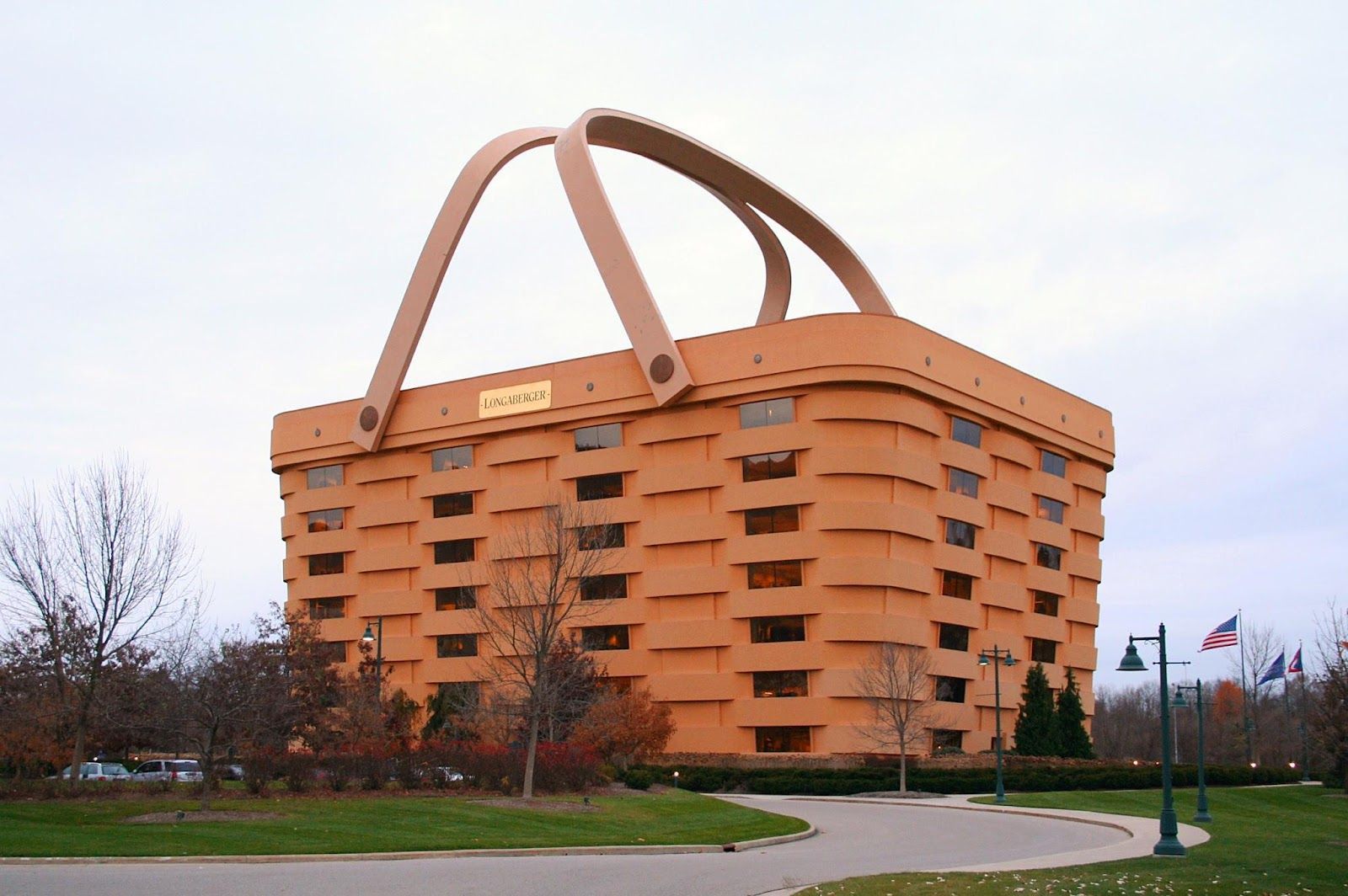
Image: Photo shot by Derek Jensen (Tysto, Public domain, via Wikimedia Commons

Who says a building has to look traditional to be iconic? Why settle for an ordinary office building when you can work inside a basket? That's what the executives of the Longaberger Company, an American manufacturer and distributor of handcrafted maple wood baskets, thought when they relocated to Newark, Ohio, in 1997.

Their headquarters was designed as a seven-story building, a perfect replica of the company's top-selling product, the Medium Market Basket. The massive handles are attached to the structure with copper and wooden rivets, and the gold-leaf-plated tags each weigh 725 pounds. Though the building was a novelty, the company eventually abandoned it, and it is now listed for sale.

4
Empire State Building Wedding Club

Image: William Wachter

Popping the question on top of the Empire State Building has become a cherished tradition in the United States. Thousands of couples travel from all over the country to get engaged at one of New York City's most iconic buildings. But did you know that you can also celebrate a wedding there?

Every February 14, a few lucky couples are granted the unique opportunity to exchange wedding vows at the building's 86th Floor Observatory. Since 1994, hundreds of couples have said "I do" at this breathtaking location, celebrating Valentine's Day at America's most romantic landmark.

5
A supernatural castle

Image: Michelle_Raponi

Creativity, ingenuity, and perseverance can achieve extraordinary feats. Such is the case with Coral Castle, a massive limestone structure built by self-taught engineer Edward Leedskalnin in the early 20th century.

Located just north of Homestead, Florida, sits this construction built with stones larger than those at Stonehenge. Leedskalnin, who invested more than 28 years in this project, claimed that he raised it single-handedly using reverse magnetism and supernatural abilities. The truth is he probably used pulleys and other tools, but that doesn’t make it any less of a unique and original building that is a fascinating tourist attraction to this day.

6
Walt Disney's utopian city

Image: Paul Moody

Walt Disney was a visionary, and thanks to his infinite imagination today we have the most endearing characters and the best amusement parks in the world. But did you know that Disney originally envisioned his famous EPCOT Center as the blueprint for a larger utopian society?

EPCOT stands for Experimental Prototype Community of Tomorrow. Had Disney’s dream come to fruition, 20,000 people could have lived in a real, futuristic city complete with residential areas, shopping malls, factories, recreational parks, and a state-of-the-art multimodal road system to connect it all. Unfortunately, after his death in 1966, the company felt his original vision was a bit impractical. Instead, they created a theme park that captures the spirit of its creator, a permanent celebration of human achievement, from culture to technological innovation.

7
Secret codes

Image: Pixabay

The CIA is a mysterious organization, so it's no wonder that there is a sculpture hiding secrets sitting right in the courtyard of the George Bush Center for Intelligence in Langley, Virginia.

Named "Kryptos," this large copper sculpture was installed in 1990 and holds a series of four encrypted messages. Only three of these codes have been cracked, while the fourth remains one of the most famous unsolved cryptograms in the world.

8
The paper house

Image: Daderot, Public domain, via Wikimedia Commons

It seems that the 1920s was a time of inventiveness, innovation, and originality in architecture. During this decade, the United States built the most impressive skyscrapers and, as we've explored, even a massive limestone castle. But a house made of paper? It seems almost impossible, doesn’t it?

Well, we are about to prove you wrong. In 1924, a mechanical engineer called Elis Fritiof Stenman built a summer cottage made almost entirely out of pasted, coated, or rolled-up newspapers. The only exceptions were the framework, floorboards, and shingles. The house is located in Rockport, Massachusetts, and, believe it or not, is still standing and can be visited.

9
Race into the sky

Image: roberto_bellasio

The Chrysler Building on the East Side of Manhattan in New York City was once the world’s tallest building, holding the title for 11 months. But did you know that it almost didn't make it? Industrial pioneer Walter Chrysler, who commissioned the project, wanted his building to be taller than the Eiffel Tower. Originally designed to be 925 feet tall , the imminent construction of other taller skyscrapers forced architect William Van Alen to revise his plans.

This competition for the title of the world’s tallest building became known as the " Race into the Sky ." To beat his opponents, Van Alen ordered a 125-foot spire to be built in secret. It would only be attached to the roof after the rival buildings were finalized. When it was finished in May 1930, the Chrysler Building reached 1,046 feet, making it the tallest man-made structure in the world at the time. Unfortunately, less than a year later, the Empire State Building would claim that honor.

10
A laboratory under the sea

Image: NEOM

Did you know the world's only undersea research laboratory is located in the United States? Sixty-six feet below the surface of the ocean off the coast of Florida lies Aquarius Reef Base, an underwater lab where researchers work for up to ten days at a time.

Aquarius is dedicated to the study and preservation of coral reefs, fish, and aquatic plants. The facility is currently operated by Florida International University and contains sophisticated state-of-the-art lab equipment.

11
Give me the time of day

Image: Leo_Visions

A bridge that tells time? We are not kidding! When it’s not being used by pedestrians and cyclists to cross the Sacramento River in Redding, California, the Sundial Bridge at Turtle Bay serves as a giant timepiece.

The bridge's 217-foot support tower points north, and its shadow can be used to calculate the time. Designed by renowned Spanish architect Santiago Calatrava, it was completed in 2004. So now you know, if your watch breaks or your cell phone dies on your way to Turtle Bay Exploration Park, you don't have to worry, the Sundial Bridge will always tell you the time of day!

12
The Capitol Subway System

Image: Harrison Haines

Few people know that a network of subway cars runs beneath Washington’s labyrinthine Congressional headquarters. The first Capitol Subway System opened on March 7, 1909, and has been transporting politicians seeking shelter from the weather—and curious onlookers—for more than a century.

The rails stretch for nearly a mile, connecting the United States Capitol to several congressional office buildings. While the public can ride the trains, the subway is restricted to congressional members and staff during votes.
General General 3 min read

Big names for small creatures

Bird is the word: 10 American bird names explained

Image: Dulcey Lima

A world without birds would be a gloomy one, indeed. These feathered friends grace our skies and brighten our days with their songs, not to mention the important environmental roles they fulfill. The names we give them often showcase their characteristics or pay homage to the people who discovered them. Scroll on to learn about ten of the most common birds and their names. How many of these did you know?

1
Mourning Dove

Image: Anish Lakkapragada

The melancholic name of the mourning dove comes from its sad call , which the casual listener might mistake for an owl. Mourning Doves inhabit a wide range of open habitats, including suburbs and urban parks.

Their call is generally referred to as the "perch coo," a song sung by an unmated male from a perch. These birds have other well-known nicknames, such as "turtle doves" and "rain doves."

2
Northern Mockingbird

Image: Tyler Jamieson Moulton

More than just mockers, mockingbirds are expert singers, continuously adding new imitations of other birds' songs to their repertoires and sometimes mimicking unnatural sounds, such as car alarms. Northern mockingbirds may learn up to 200 different sounds.

These medium-sized, long-tailed gray songbirds prefer open habitats with a scattering of shrubs and small trees. They eat a wide variety of fruits, invertebrates, and even small vertebrates, such as lizards.

3
White-breasted Nuthatch

Image: Patrice Bouchard

You can recognize this bird by its white face and underside, bluish back and wings, dark crown, nasal "yank-yank" call, and its habit of creeping down tree trunks headfirst.

The name "nuthatch" is derived from "nut hacker," reflecting the bird's method of opening up nuts by jamming them into a crevice and then hammering at them.

4
Downy Woodpecker

Image: Joshua J. Cotten

The smallest woodpecker in North America, the Downy Woodpecker is a stubby-billed, black-and-white bird that inhabits deciduous woods and tree-filled urban and suburban parklands. It forages on trees, shrubs, and large weeds for insects and other arthropods.

The "downy" in this bird's common name refers to the soft, white feathers of its long, white back stripe . The "woodpecker" part refers to the fact that this bird pecks bark, looking for termites hidden underneath it.

5
House Finch

Image: Patrice Bouchard

Originally found only in the West, the House Finch was introduced to the eastern U.S. in 1939, when a few individuals were released from a pet store. The word "finch" comes from the German idiom fink , which refers to a lively or cheerful person —a description that certainly fits this active and gregarious songbird. The term "house" refers to the bird’s tendency to hang around human dwellings.

6
Song Sparrow

Image: Patrick Fobian

Song Sparrows, as their name suggests, sing a cheerful and recognizable song. Although these birds can be found in a wide range of habitats, their favorite spots are often close to streams and other sources of fresh water.

The English word "sparrow" derives from the Anglo-Saxon word spearwa . This term means "flutterer," an apt description for this active songbird.

7
Ruby-throated Hummingbird

Image: Joshua J. Cotten

The only hummingbird that regularly breeds in the eastern U.S. is the Ruby-throated Hummingbird. The male's metallic-looking red throat, or "gorget," explains the first part of the name. And the hummingbird part comes from the humming sound their wings make as they fly.

8
Blue Jay

Image: David Bridle

The "bullies" of the birdfeeder, Blue Jays' name comes from the bird's noisy, garrulous nature. This term has also been applied to other birds of the same family, which are generally gregarious as well.

Before approaching a feeder, Blue Jays often give harsh calls that sound like those of hawks, perhaps to scare off other birds that might compete for access to the bird seed.

9
Tufted Titmouse

Image: Paul Crook

These curiously named birds form longer-lasting family units than many other songbirds, with their younglings sometimes even hanging around for a second year to help raise younger siblings. The "titmouse" name has nothing to do with rodents, but instead comes from an Old English phrase meaning "small bird."

10
Spotted Towhee

Image: Anish Lakkapragada

Spotted Towhees are members of the sparrow family. These birds have dark heads and backs, white spots on their wings, rusty sides, and striking red eyes. Their song is a simple trill.

The name "towhee" is a simulation of the bird's call and it was coined in 1731 by the naturalist and bird artist, Mark Catesby.

General General 4 min read

Slippery, spotty, and surprising

These local amphibians can regrow limbs, release toxins, and much more!

Image: Pixabay

Given America's vast territory and rich biodiversity, our land holds a wide variety of mammals, reptiles, and birds—but let's not forget the amphibians! The United States is home to a great and extravagant range of amphibians that are far more fascinating than just regrowing tails: Some well-known and others that you'll definitely want to discover. Join us as we explore the unique traits of these 10 incredible amphibians found across the US!

1
Tiger salamander

Image: Anastasia Pirri

Meet the tiger salamander—one of the largest terrestrial salamanders in North America. While its size is certainly impressive, the tiger salamander also has other traits that make it stand out. Take its appearance, for example: its dark brown body with bright yellow blotches resembles tiger stripes, which is why it has such a peculiar name. But there's more! Unlike many other salamanders, this one spends much of its time underground, using its large, powerful limbs to dig.

Fun fact: Some states, like Colorado and Kansas, have named it their official state amphibian!

2
Eastern Hellbender

Image: laura adai

Although the tiger salamander is impressively large, another salamander stands out for its huge size: the Eastern Hellbender.

Cryptobranchus alleganiensis alleganiensis is its scientific name (quite a mouthful, right?). It holds the title of the largest salamander in North America. In fact, it's sometimes nicknamed "snot otter" due to its large body and the slippery texture of its skin.

3
Amphiuma

Image: Wolfgang Hasselmann

When you first see this creature, you might mistake it for a snake or an eel. But it's actually an amphibian—more specifically, an aquatic salamander known as the amphiuma. Its appearance, let’s just say, isn’t exactly what most would call "cute."

This unusual amphibian can grow up to 3 feet long! And while not immediately noticeable, it has tiny legs with only one, two, or three toes, depending on the species. Its limbs aren't very useful, but they do make the amphiuma look just a bit creepier.

4
Colorado River Toad

Image: Crystal McClernon

The Colorado River Toad may not be the cutest or most dazzling creature out there, but it's certainly one of the most fascinating. Native to the southwestern United States, this amphibian is one of the largest toads in North America, but what sets it apart isn't its size. So, while it may look slow and harmless, this toad is capable of releasing a dangerous, highly psychoactive toxin that acts as a defense mechanism and can be fatal to many species, including dogs.

5
Common Mudpuppy

Image: Tommy Bond

Now, it's time for an amphibian whose cuteness is one of its most distinctive features; even its name reflects that! We're talking about the Common Mudpuppy, an aquatic salamander that inhabits streams, rivers, ponds, and lakes. It's also one of the few salamanders that remain fully aquatic throughout their entire life. And that’s precisely why it sports a pair of large, red external gills on the sides of its head, giving it an almost 16th-century European look!

6
Gray Tree Frog

Image: Aurora K

The small Gray Tree Frog inhabits the forests and woodlands of the eastern United States. And while it's true you might find it on trees and plants, its nickname isn't entirely accurate when it comes to color. Yes, it can be gray, but this amphibian has the ability to change its color to blend in with its surroundings! It also has another superpower: the ability to survive freezing temperatures. By producing a natural antifreeze, it protects its organs during cold conditions that most of us couldn’t begin to handle.

7
Spotted Salamander

Image: Kristina Kutleša

As its name suggests, what distinguishes the Spotted Salamander is its shocking look. But beware, its mottled appearance isn't just for show. It also acts as a warning to ward off predators! If you've ever seen one in the wild, consider yourself lucky because although it’s fairly widespread, this salamander spends most of its time underground.

8
Pacific Giant Salamander

Image: wallace Henry

If you venture into the mountainous regions of the Pacific Northwest, you might come face-to-face with the Pacific Giant Salamander, one of the largest terrestrial salamanders in North America.

Reaching up to 14 inches in length, this amphibian is striking to see—but it’s even more surprising when you hear it. That’s right: unlike most of its kind, the Pacific giant salamander can make audible barking sounds!

9
Barking Tree Frog

Image: José M. Alarcón

We have a contestant that could go head-to-head with the Pacific Giant Salamander in a barking contest: the aptly named Barking Tree Frog.

Let’s just say the frog’s striking features are perfectly summed up by its name. In states like Florida, Georgia, and South Carolina, you can find this little amphibian calling from the treetops or near freshwater shores.

10
Dusky Gopher Frog

Image: Geraldine Dukes

Finally, we have the most mysterious and elusive of all: the Dusky Gopher Frog. As one of the rarest frog species in the U.S., the Dusky Gopher Frog is incredibly elusive and critically endangered, with fewer than 200 individuals left in the wild. The dusky frog spends most of its life hidden underground and only comes out during the mating season.

Explore more American facts

Choose your favorite category!

General
General

As American as apple pie—the very best America has to offer!

Culture
Culture

Delve into the astounding richness of American lore.

Geography
Geography

Hop in and explore vast and diverse American landscapes.

History
History

Discover the key moments that shaped the United States.