History History 5 min read

MOST WANTED

Do You Recognize These 10 Outlaws Who Captured the Nation's Attention?
In the annals of history , some people have dominated the skill of breaking and evading the law. Immortalized in numerous stories both written and oral, and depicted in movies and other forms of art, these American outlaws-–like Billy the Kid or Bonnie and Clyde— have earned a questionable fame that kept them alive long after they left this world. Follow us as we tour the names and lives of these 10 infamous American outlaws!

1
Jesse James

Image: Jaye Haych

Born in 1847 and raised in western Missouri , Jesse James and his brother Frank earned a reputation robbing banks, trains, and stagecoaches, and committing other offenses throughout the Midwest .

After gaining national fame as an elusive criminal, Jesse James's illegal career came to an end in 1882 . He was betrayed by one of his own, Robert Ford , who had met with the governor of Missouri to make a deal and bring James down.

Jesse James lived only 34 years, but the wild story of his life is full of infamous acts that seem like something out of a movie. And here's a fun fact: his son, Jesse James Jr., starred in two silent films playing his father!

2
Billy the Kid

Image: rod m

Ever heard the name Henry McCarty ? Maybe the alias William H. Bonney? If the answer is "no," you probably recognize him by his nickname: Billy the Kid .

In addition to committing robberies and assaults, this 19th-century outlaw gained notoriety for his role in New Mexico's Lincoln County War. Billy, born in 1859 , was arrested several times throughout his life but consistently managed to escape. However, his luck ended in the 1880s.

In the year 1881 , to be exact, Billy the Kid was caught by Sheriff Pat Garrett. That same year, a few months after his last escape, he was struck down at the young age of 21 by Garrett.

3
Butch Cassidy

Image: The National Library of Norway

You've probably heard of the Wild Bunch , a gang that intimidated the American West during the late 19th and early 20th centuries . Often considered the most successful train robbery gang in history, its members were feared guys, but the most notorious was its leader: Butch Cassidy.

Cassidy, born in 1866 , started his criminal career very early. Many historical sources state that he committed his first minor crime—store robbery—when he was only 14 years old !

However, as with most outlaws, his luck ran out. Escaping the law, he traveled to Latin America. The tales say he was in Argentina and then Bolivia , where he met his end in a shootout in 1908 .

4
Sundance Kid

Image: Ady TeenagerInRO

Another iconic figure in Cassidy's gang was Harry Alonzo Longabaugh, more famously known as the Sundance Kid .

Born in 1867 , his distinctive nickname originated during his time in the Sundance, Wyoming, jail, where he landed for one of his early crimes, horse theft. Legend has it that the Sundance Kid was a man of many skills, known particularly for his talent for poker and his ability to escape the law.

The tales suggest that Longabaugh traveled with Cassidy to Bolivia, where he met the same fate as the gang leader. Another theory says that the Sundance Kid returned to the U.S. under another name and lived in a small town in Utah.

5
Black Bart

Image: Joanna Kosinska

While crime and poetry might seem like an unlikely pairing, the outlaw known as Black Bart managed to blend these two things very well.

Probably less famed than the other names on this list, Black Bart was born Charles E. Boles (or Bolton) in England in 1829 . However, he relocated to New York with his family when he was just a toddler.

Between 1875 and 1883, Boles is believed to have robbed about 28 stagecoaches in Northern California and southern Oregon. But one thing distinguished this outlaw: on several occasions, he left behind poems at the robbery sites!

6
Al Capone

Image: Ashim D’Silva

It might be hard to believe, but before Al Capone became synonymous with organized crime, he actually worked at a candy store ! Can you picture him among candies and lollipops?

Definitely one of the best-known gangsters of the Prohibition era , Al Capone was born in New York as Alphonse Gabriel Capone in 1899 . Born to Italian immigrants, Capone moved to Chicago at a young age. By the 1920s , he had already made a name for himself among the city's criminals, smuggling and selling alcohol.

In 1931, his luck ran out, as he was sentenced to 11 years in federal prison for tax evasion. He was released in 1939 and passed away 8 years later.

7
Bonnie and Clyde

Image: Tengyart

Some say love's power knows no bounds, and the story of this couple seems to prove this.

Bonnie Elizabeth Parker and Clyde Chestnut "Champion" Barrow, known worldwide as Bonnie and Clyde , were two outlaws who committed a wide range of crimes across states such as Oklahoma, Texas, and Missouri during the Great Depression era . Literally partners in crime, they became popular icons over the years.

These two were recurring names in the headlines of their times, gaining notoriety for their robberies, both to banks and small stores. Together until the end, Bonnie and Clyde were fatally wounded in a police ambush in 1934 , when they were still very young. At the time, she was 23 and he was 25.

8
John Dillinger

Image: Tim Evans

John Dillinger , a mobster born in 1903 , led what was known as "the Dillinger Gang." During the Great Depression , Dillinger and his crew demonstrated their criminal prowess, accused of robbing more than 24 banks !

In 1934, John Dillinger became the first person to be declared "Public Enemy Number One" by the FBI. He was imprisoned multiple times throughout his life and, as the stories go, managed to escape jail twice using fake weapons made out of wood!

After a final attempt to escape, the criminal was gunned down by the authorities at the age of 31 as he exited the Biograph Theater in Chicago.

9
Pretty Boy Floyd

Image: Pepi Stojanovski

During the turbulent Great Depression era, a couple of outlaws were not only robbing banks and trains but also the national spotlight. Among them was Pretty Boy Floyd , born Charles Arthur Floyd in 1904 .

Floyd, who operated in the Western and Central U.S. , wasn't seen as a villain by many. Why? Besides robbing banks , he also used to destroy mortgage documents , something that helped many people, relieving them of their debts. Far from the sloppy appearance of many criminals, Floyd had a clean-cut and youthful look, which earned him his characteristic nickname .

His life met an end in his 30s in a shootout with the Bureau of Investigation's agents in Ohio.

10
John Gotti

Image: Jacob Spence

Known as " Teflon Don " for his slippery ability to evade justice, John Gotti was born on October 27, 1940 , in The Bronx, New York. He's widely considered one of the most dangerous crime bosses in U.S. history.

Known for his charisma and trademark hairspray look , Gotti began his life of crime when he was still a teenager. By the mid-1980s, he had become the head of the Gambino Crime Family, and throughout his life, he was accused of multiple crimes of varying severity.

Despite evading convictions many times, he was finally convicted in 1992 . He passed away ten years later while still in prison.
General General 4 min read

Science usually starts as science fiction

Trip to Mars, anyone? Discover 10 American science fiction authors

Image: RDNE Stock project

It takes a special kind of talent to be a science fiction writer. Whether you are writing about a dystopian future or a utopian one, you are creating a new world with its own rules and systems to guide it. Long before Elon Musk started seriously considering a trip to Mars, science fiction authors were already exploring how this might turn out. Many writers have attempted this genre, but only a few have made a significant impact. The following ten belong to that prestigious group. If you haven’t read any of these authors, we encourage you to do so. Not only is it a lot of fun, but it also fuels your own imagination.

1
Ray Bradbury

Image: Rod Long

Perhaps the most emblematic name in American science fiction, Ray Bradbury was an author and screenwriter best known for his novel Fahrenheit 451 , and his short story collections The Martian Chronicles , and The Illustrated Man .

His works not only imagine what extraterrestrial colonies might be like but also explore how such experiences would affect humans on a deeply personal level. His prose is both poetic and informative, making it accessible to both young and adult readers alike.

2
Philip K. Dick

Image: Filip Filkovic Philatz

If you’ve ever seen the movie Blade Runner or the TV series The Man in the High Castle , then you’ve been exposed to the work of Philip K. Dick. This prolific novelist wrote numerous novels and short stories that explore philosophical and social questions such as the nature of reality, human nature, and characters struggling against illusory environments, monopolistic corporations, and authoritarian governments.

His novel Do Androids Dream of Electric Sheep? was the basis for Blade Runner and his works have earned him countless awards all over the world.

3
William Gibson

Image: Brian McGowan

The creator of the now-ubiquitous term "cyberspace," William Gibson was a speculative fiction writer whose works explore the effects of technology, cybernetics, and computer networks on humans (fans of Black Mirror will likely find this author to their liking).

His first novel, Neuromancer , was credited with revitalizing science fiction literature in the 1980s, and he was described in 1999 as "probably the most important novelist of the past two decades.

4
L. Ron Hubbard

Image: Luna Wang

"While he is now more famous for founding Scientology, L. Ron Hubbard was a genuine science fiction writer who authored works such as Battlefield Earth, To the Stars, Buckskin Brigades, and Death’s Deputy , among other titles.

Hubbard was quite a prolific pulp science fiction and fantasy writer in his early career and, in 1950, he published Dianetics: The Modern Science of Mental Health , establishing organizations to promote and practice Dianetics techniques.

5
Theodore Sturgeon

Image: Rod Long

A critic turned writer, Theodore Sturgeon wrote over 120 short stories, 11 novels, and even a handful of scripts for the original Star Trek television series. His first science fiction novel, More Than Human , won the 1954 International Fantasy Award for that year's best novel.

Though he was not as well known to the general public as contemporaries like Isaac Asimov or Ray Bradbury, Sturgeon gained recognition among readers of mid-20th-century science fiction anthologies. At the height of his popularity in the 1950s, he was the most anthologized English-language author alive.

6
Alfred Bester

Image: Steve Johnson

One of the few writers credited with inventing modern science fiction, according to one of his colleagues, Alfred Bester was an author, TV, radio, and comics scriptwriter, and magazine editor. His novel, The Demolished Man , was the first winner of the Hugo Awards in 1953.

While working as a scriptwriter for DC Comics, he created the supervillain Solomon Grundy and also wrote extensively for television, magazines, and radio.

7
H. P. Lovecraft

Image: Alejandro Piñero Amerio

An author whose work is as famous in the science fiction genre as it is in horror, H. P. Lovecraft was a writer of science fiction, fantasy, horror fiction, and a mixture of all these genres. His most notable work is the Cthulhu Mythos .

Some of his more popular works include The Call of Cthulhu, At the Mountains of Madness, The Shadow over Innsmouth , and The Shadow Out of Time . The central theme of his books is cosmicism, a theory dictating that "there is no recognizable divine presence, such as a god, in the universe, and that humans are particularly insignificant in the larger scheme of intergalactic existence."

8
Frank Herbert

Image: Pierre Bamin

Franklin Patrick Herbert Jr. is best known for writing the best-selling science fiction novel of all time, 1965's Dune , along with its five sequels. He also wrote short stories and worked as a newspaper journalist, photographer, book reviewer, ecological consultant, and lecturer.

His famous saga, set in the distant future and spanning millennia, explores complex themes, such as the long-term survival of the human species, human evolution, planetary science and ecology, and the intersection of religion, politics, economics, sex, and power in a future where humanity has long since developed interstellar travel and colonized thousands of worlds.

9
Ursula K. Le Guin

Image: Karsten Klemme

With a literary career spanning nearly sixty years, Ursula Kroeber Le Guin is another legendary name on this list. She is best known for her works of speculative fiction, including science fiction works set in her Hainish universe and the Earthsea fantasy series.

Frequently described as a science fiction author, Le Guin has also been called a "major voice in American letters," though she once said she would prefer to be known as an "American novelist."

10
Orson Scott Card

Image: Greg Rakozy

The only person to have won a Hugo Award and a Nebula Award in consecutive years, both for his novel Ender’s Game , and its sequel, Speaker for the Dead , Orson Scott Card is a science fiction writer who often features characters with exceptional gifts who make difficult choices with high stakes. Since 1979, he has published over 50 novels and 45 short stories.

During his childhood, Card read children's classics and popular novels, his favorite book being Mark Twain's The Prince and the Pauper . He often refers to works by Robert A. Heinlein and J. R. R. Tolkien as sources of inspiration.

General General 4 min read

Behind the banners

11 U.S. state flags and their hidden meanings

Image: Drei Kubik

Flags are more than mere symbols—they tell stories, capturing the history, pride, and values of each state they represent. Every element, from colors to symbols, was thoughtfully chosen to convey a message tied to the spirit of the state. Join us on a journey across the country as we explore 11 unique state flags and the rich stories behind them.

1
Texas

Image: Joshua J. Cotten

Also known as the Lone Star, Texas’ flag features a single star on a vertical blue stripe, representing the state’s strong independent spirit. The red stripe represents courage, while the white stripe stands for purity.

In fact, the current design was adopted in 1839 during the Republic of Texas, echoing the state's history as an independent republic before joining the Union in 1845.

2
California

Image: Lesli Whitecotton

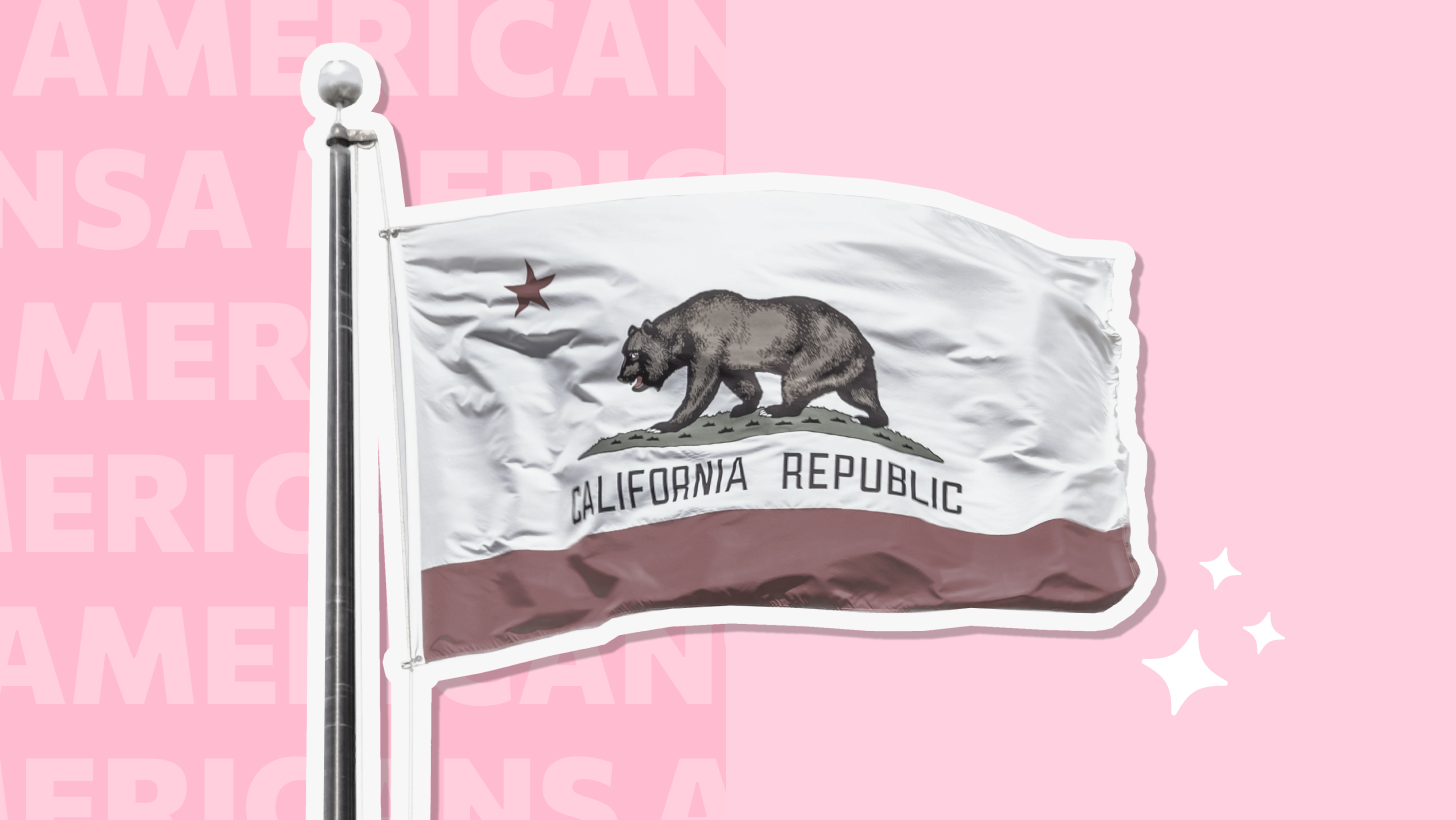
California's flag features a grizzly bear, a symbol of strength and independence. The star represents California's status as a republic in 1846 during the Bear Flag Revolt, and the red stripe signifies courage.

Interestingly, the bear depicted on the 1911 version of the flag is said to have been inspired by the last California grizzly bear held in captivity.

3
Arizona

Image: Denisse Leon

Arizona’s flag features a golden star surrounded by red and gold rays, symbolizing both the state’s arid landscape and copper mining industry. The blue and red colors are the same shade used on the flag of the United States.

The star commemorates Arizona’s statehood, achieved in 1912, while the thirteen rays symbolize the original Thirteen Colonies.

4
Colorado

Image: Courtney Cook

Colorado’s flag features blue, white, red, and yellow with a bold "C" encircling a golden disk. The blue symbolizes the sky, gold represents the state’s abundant sunshine, white the snowcapped Rockies, and red the "ruddy" earth.

The gold and white elements also honor Colorado’s gold and silver mining industries. Officially adopted in 1911, the flag stands as a tribute to the state’s natural beauty and pioneering heritage.

5
Florida

Image: Karl Callwood

Florida’s flag features a red cross with the state seal at the intersection. The cross represents the state's Spanish heritage, as it was originally founded by Spanish explorers.

The seal depicts a shoreline where a Seminole woman spreads flowers. While some suggest the woman represents the historical heroine Milly Francis, there is no evidence to support this theory. A Sabal palm and a steamboat complete the scene, reflecting Florida's vibrant scenery.

6
Maryland

Image: Gary Cole

Maryland’s flag stands out with its bold black and gold pattern, divided into quarters. The design incorporates elements from the family crest of the Calverts, the state’s founding family.

During the colonial era, Maryland used only the gold and black Calvert arms. The colors fell out of use after American independence but were reintroduced in 1854.

7
South Carolina

Image: Kelly

South Carolina’s flag features a white palmetto tree on a blue field, with a crescent moon beside it. The roots of this design have existed in some form since 1775, being based on one of the first American Revolutionary War flags.

An early version of this flag, known as the Moultrie Flag, was famously flown during the defense of a fortress on Sullivan's Island against the British fleet. The palmetto tree was later added as a symbol of the island’s successful defense.

8
Tennessee

Image: Brandon Hooper

Tennessee’s flag features three stars arranged in a triangular pattern, symbolizing the three regions of the state —East, Middle, and West Tennessee. The red, white, and blue colors align with the state’s commitment to unity and its place in the Union.

The current version, designed by Colonel Le Roy Reeves, was adopted in 1905. However, an earlier version already aimed to represent the state's three distinct regions with three slanted bars of red, white, and blue.

9
Hawaii

Image: little plant

Hawaii’s flag is unique among U.S. state flags. It features a Union Jack in the upper left corner, reflecting the historical ties between Britain and the Hawaiian Kingdom. It was first adopted in the early 19th century by the Kingdom of Hawaii and retained when the state joined the U.S. in 1959.

The eight horizontal stripes represent the eight main islands of Hawaii: Hawaiʻi, Maui, Kahoʻolawe, Lānaʻi, Molokaʻi, Oʻahu, Kauaʻi, and Niʻihau.

10
Indiana

Image: Lucas Beck

Indiana’s flag features a large gold torch, with 19 smaller stars surrounding it, representing Indiana's status as the 19th state to join the Union. The torch symbolizes enlightenment and the path to progress.

Adopted in 1917, the flag’s design was chosen through a contest offering a cash prize. The winning design, created by Paul Hadley of Mooresville, Indiana, was selected as the official flag with only minor modifications.

11
Maine

Image: Aubrey Odom

Maine’s flag features a shield with a pine tree at its center, flanked by a farmer and a sailor, representing the state’s agricultural and maritime heritage. The North Star above the shield symbolizes guidance and Maine’s motto, "Dirigo," meaning "I Lead."

The pine tree is a nod to Maine’s nickname as the Pine Tree State. Adopted in 1909, the flag’s design emphasizes Maine’s strong connection to its natural resources.

Explore more American facts

Choose your favorite category!

General
General

As American as apple pie—the very best America has to offer!

Culture
Culture

Delve into the astounding richness of American lore.

Geography
Geography

Hop in and explore vast and diverse American landscapes.

History
History

Discover the key moments that shaped the United States.