General General 3 min read

Speakeasies and other secrets

Doctors did what? 10 shocking Prohibition facts they didn't tell you!

Image: Mister Mister

With the passage of the 18th Amendment in 1919, the Prohibition era began, lasting a long 13 years. It was a time when just about everything happened... but all in secret! Beyond the now-famous speakeasies, there are plenty of surprising events from this chapter of our history that you might not know! So, without further ado, let's uncover these 10 incredible facts about Prohibition!

1
The doctor said so

Image: Vinicius Amano

It's not news that alcohol was completely banned across the country from 1920 to 1933. But, you know, every law has its loophole. It's said that during Prohibition, some doctors took advantage of their authority to prescribe a peculiar medicine: whiskey! Well, if the doctor prescribed it, what could the cops possibly argue?

2
The queen

Image: Daniel Vogel

Women also played an important role during Prohibition on both sides of the law! One of the most notorious was Cleo Lythgoe, a.k.a. the "Queen of the Bootleggers." As her nickname suggests, she was one of the most successful bootleggers of those years. That's right! She built an empire, running a major underground operation that supplied alcohol to secret bars.

3
Clever marketing

Image: April Klein

Although they feel like something recent, marketing strategies have been around for a long time. In fact, even during Prohibition, clever sales tactics flourished by exploiting the nation's circumstances. This was the case with the so‑called "grape bricks," blocks of concentrated grape juice that came with some rather peculiar warnings, such as "NOT to dissolve in water, add yeast and store in a cool place for 21 days, or it may ferment and turn into wine."

4
NASCAR

Image: Simon Hurry

Although it may seem like nonsense, NASCAR's origins are closely related to bootlegging during the Prohibition era. The "moonshiners" were those who transported illegal alcohol. These drivers were skilled, relying on speed and sharp maneuvers to outrun the law. Those same driving techniques later helped give rise to stock car racing.

5
Sacramental

Image: Rey Proenza

Prohibition was full of loopholes. But undoubtedly, one of the most obvious ones was the allowance for sacramental wine. Since wine used in church masses was permitted, it led to more people attending certain services, and even the rise of some pseudo-religions!

6
A payment issue

Image: Mackenzie Marco

Prohibition agents were in charge of enforcing the dry law. However, there was one big problem the authorities overlooked: these agents were poorly paid. That small detail helped the illegal liquor trade thrive. Since agents weren't well paid, bootleggers found them easy to bribe.

7
Risky times

Image: Nick Fewings

The fight against alcohol sales was far from easy, and historical records suggest that, as a result, the authorities took some drastic measures. One of them was the decision to add highly toxic chemicals to the alcoholic beverages circulating at the time! But here's the most surprising part: many people knew -or at least suspected- and still drank their gin and tonic anyway!

8
A lot

Image: Sérgio Alves Santos

We know that Prohibition gave rise to the famous speakeasies, and we know there were a lot of them, but how many? Well, because they operated in secret, it's hard to know exactly how many speakeasies existed across the country. Still, one fact gives us a clear picture of that time: Speakeasies actually outnumbered the bars that existed before Prohibition.

9
The man in the green hat

Image: JOSHUA COLEMAN

Bootleggers were everywhere, even where you'd least expect them. During the Prohibition years, there was one man who operated as the main bootlegger of Congress. He was nicknamed "The man in the green hat" as a reference to his trademark green fedora.

10
After sunset

Image: Anna Asryan

In Detroit, the Police Department grew tired of constantly chasing smugglers down the Detroit River. As these chases were extremely risky and often ended in accidents, the Detroit Police Department adopted an unofficial policy: "No active chases after sunset." As you can imagine, this gave smugglers a lapse of time each night to move without worry.
Culture Culture 4 min read

Rediscovering the inventor

Did he save a child's life? Discover 10 fun facts about Thomas Edison!

Image: WikiImages

The history of the United States of America wouldn't be the same without the contributions of Thomas Edison. Known for being a great businessman and inventor who patented more than 1,000 creations, Edison also had many other facets you may not have known about. From strange marriage proposals to his poetic last words, join us to discover 10 incredible facts about the Wizard of Menlo Park!

1
Young inventor

Image: Randy Fath

Although we all know that Edison was an inventor -and one of the best- very few know that his passion was already loudly expressed at the young age of 10.

At that age, while other children were naturally playing ball in the park, Edison was already interested in chemistry, physics, mathematics, and electricity. At 12, he set up his first laboratory in the basement of his parents' house, where he began to do his first experiments! Some stories claim that explosions in the basement were more frequent than their parents would have liked.

2
Self-taught

Image: Nicola Tolin

Edison's educational path was very different from the one many of us probably had. In fact, Edison had almost no formal education.

Thomas Edison attended school for only a few months. Due to some hearing problems he developed as a child, his mother decided to homeschool him, teaching and encouraging him, which awakened his impressive curiosity and appetite for knowledge.

By the time he was a preteen, he was already an autodidact. This fact was crucial on his way to becoming one of our country's most important inventors.

3
Young entrepreneur

Image: Jingda Chen

The young Edison was not only curious and intelligent; he was also an entrepreneur.

When he was just a boy of 12, he sold snacks, candy, cigars, magazines, and newspapers on the Grand Trunk Railroad. From that age, he displayed a determined character, which enabled him to raise money for his experiments.

But his ambition was so strong that he started his own newspaper, the Grand Trunk Herald. That's right! Little Edison assembled and printed his newspaper and sold it to passengers and people who frequented the train stations.

4
Hero

Image: Sugden Guy sugden

Did you know that Edison was also a hero? That's right!

In fact, we could say that his act of heroism as a teenager was the event that started his great career. By the age of 15, Edison was working and traveling on the Grand Trunk Railroad, where he became close to a station master and telegraph officer. One day, Edison spotted the station master's two-year-old son playing on the tracks as a train sped toward him. Without hesitation, he jumped and rescued the child.

The boy's father was so grateful that he offered to teach Edison how to use the telegraph system. And what do you think? He accepted immediately!

5
Marriages

Image: Fernando @cferdophotography

Between labs and experiments, Thomas Edison also had time for love.

Thomas Alva Edison married twice in his life. His first wife was Mary Stilwell Edison, whom he married in 1871. Mary and Thomas had three children. Sadly, she passed away in 1884 after 13 years of marriage.

His second marriage was in 1886 to Mina Miller Edison. With her, Edison had three more children. As it couldn't be otherwise, it's said that Edison asked Mina to marry him in a rather peculiar way: he proposed using Morse code!

6
His children's nicknames

Image: Sandie Clarke

Thomas Edison's creativity was evident in everything he did, and there's an anecdote that exemplifies this perfectly.

The inventor's passion and humor blended and resulted in fun and loving nicknames for his first two children. As we told you, by 1876, Edison already had two children from his first marriage. They were Marion and Thomas Jr., whom Edison called "Dot" and "Dash," respectively. Yes, you got it: it was a reference to Morse code!

7
First phonograph recording

Image: Call Me Fred

As you probably know, in 1877, Thomas Edison introduced the phonograph. It was the first device capable of recording and reproducing sound!

As a result of his experiments, this device completely changed the history of communication. But what did the first recording made with the phonograph say?

Edison made a cute choice for his first recording: a recitation of the beloved nursery rhyme "Mary Had a Little Lamb." That was the first time in history that anyone heard a previously recorded voice!

8
His work team

Image: The National Library of Norway

It seems that Edison had a tendency for affectionate nicknames and monikers.

Edison didn't reserve nicknames just for his children; he also gave them to the members of his large staff. Many people worked in Edison's famous laboratory at Menlo Park, which he referred to as his "invention factory." Engineers, scientists, technicians, and people with different kinds of expertise gathered there to help make the great inventor's ideas possible. Edison affectionately referred to them as his "muckers," a nickname that shows not only his sense of humor but also his strong team spirit.

9
His health

Image: Dan Meyers

One of the best-known aspects of Edison's health was his hearing loss when he was very young. Contrary to what one might think, Edison stated that this fact didn't negatively affect his career development. In fact, he believed it helped him focus and dedicate more time to his inventions and discoveries.

However, as an adult, he developed some other health problems. Some sources suggest that Edison's habits, including long hours in the lab and a poor diet, contributed to health issues like heart problems and diabetes.

10
His last words

Image: Jonathan Borba

Edison's life was full of adventures, discoveries, love, and many other things. The American inventor didn't abandon his creativity even when it was time for him to leave this world.

It's said that, at the age of 84 on his deathbed, Thomas Edison looked at his wife, Mina, and uttered the words, "It's very beautiful over there."

While it's difficult to make a unique interpretation of these nice and calm words, their poetic and inspirational character is undeniable.

General General 4 min read

Wave them with pride

Honoring the states: learn about the history of 10 state flags

Image: Tina Chelidze

From the 13 colonies to the consolidation of the 50 states, America’s journey of growth and unity is remarkable. Each state is unique, with distinctive features, mottos, and, of course, flags. Each flag tells a story and honors the rich history and heritage of the state it represents. Among the 50 state flags, we’ve chosen 10 state flags to learn about their design, elements, and the history they represent.

1
New York

Image: Clker-Free-Vector-Images

New York was one of the 13 original colonies and is one of the most populated states today. Its flag, with a vibrant blue in the background, features a sun symbol, one supporter on each side, and the state’s inspiring motto "Excelsior," meaning "ever upward."

The scene in the coat of arms paints a picture of the Hudson River flanked by Liberty on the left, and Justice on the right. Topping it all off is a bald eagle, always majestic, perched atop the world. Powerful, isn’t it?

2
California

Image: Clker-Free-Vector-Images

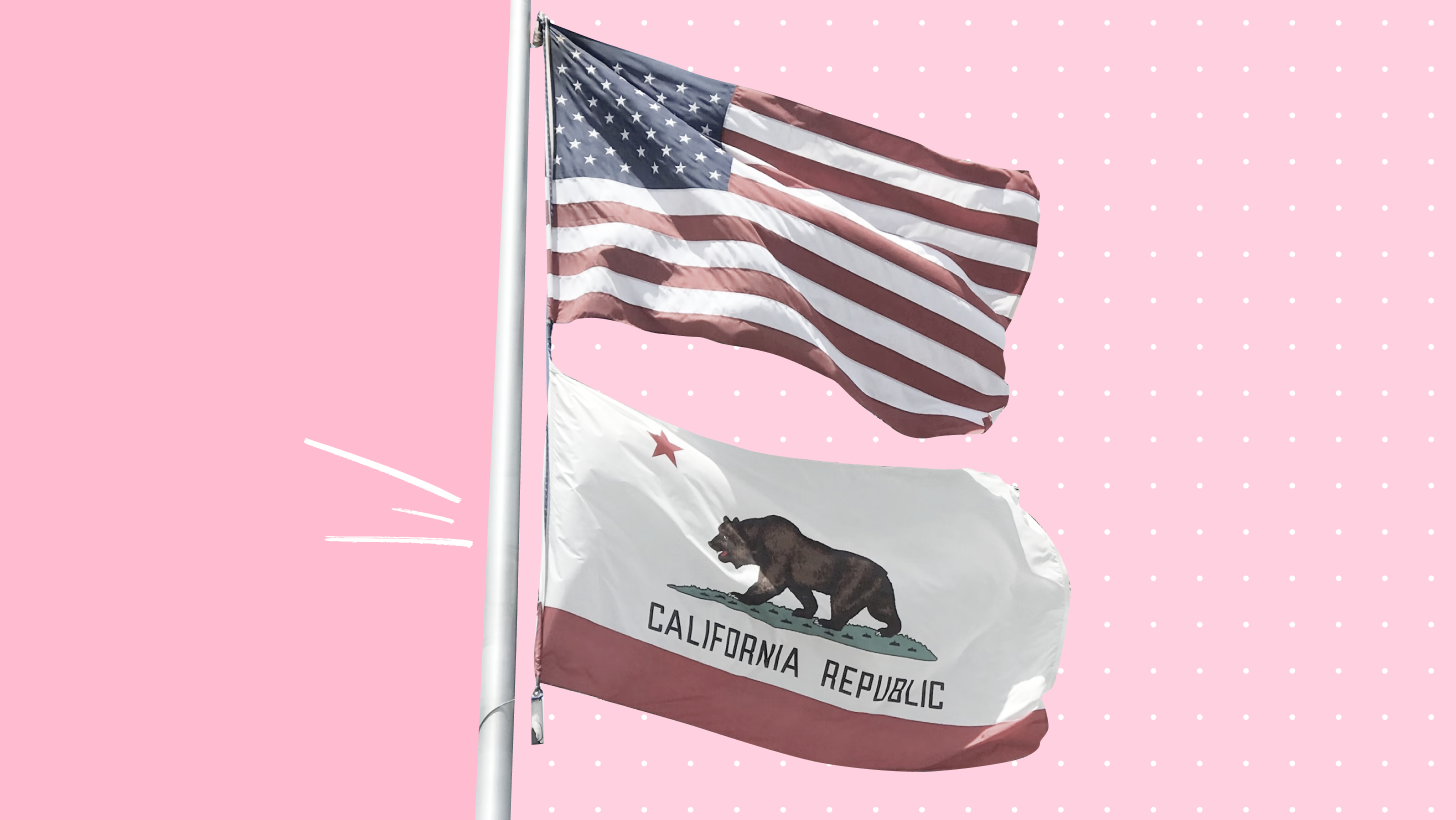
California was the 31st state to be admitted to the Union (1850) and the history behind its flag has elements present in previous models of banners used by what we know today as Mexico.

This flag was first hoisted in 1846 after American settlers in the territory fought for its independence. Finally, it was recognized as official in 1911.

The flag depicts a grizzly bear —also the official state animal— and a lone red star symbolizing previous attempts to gain independence.

3
Indiana

Image: Clker-Free-Vector-Images

Indiana’s flag was designed by Paul Hadley and approved as the state flag in 1917 after the Daughters of the American Revolution held a flag design contest.

Over the dark blue flag stands a golden torch surrounded by 19 stars . The 13 stars on the outer circle represent the 13 original colonies, while the five stars in the inner circle were added to symbolize the next five states that joined the union, Indiana being the 19th.

The torch? You guessed it right, it represents liberty and enlightenment.

4
Louisiana

Image: Clker-Free-Vector-Images

Blue background abounds among the official state flags and it’s no surprise since it’s one of the national colors. Louisiana’s flag is not the exception.

This flag is the only one to depict a pelican nurturing its offspring in a nest. What is curious about it is that the pelican, an animal that symbolizes devotion to progeny, is crying tears of blood, which represents sacrifice. Underneath, belted in a white ribbon, the state’s motto: "Union, Justice, and Confidence".

5
New Jersey

Image: Clker-Free-Vector-Images

New Jersey’s flag is the only state flag to have a buff background , although it is wrongly depicted as yellow most times. This background color represents the uniform worn by soldiers from New Jersey’s regiments in the Revolutionary War.

In the center of the flag, there is a coat of arms supported by Liberty and the goddess Ceres, representing agriculture. Above the coat of arms, a horse’s head that stands for strength, and, below it, a helmet that symbolizes sovereignty.

6
Arkansas

Image: Clker-Free-Vector-Images

Arkansas’s flag depicts a complex symbolism using well-known elements: a diamond shape, with 25 stars on the outer part, the state’s name in the middle, one star above, and three stars below.

Arkansas was the 25th state to join the union, hence the stars around the diamond. The star over the word "Arkansas" represents the Confederacy to which it was admitted in 1861. The three stars below represent different things: the nations Arkansas belonged to, the Louisiana Purchase, and the fact that it was the third state formed after such purchase. A simple design, yet a complex meaning, don’t you think?

7
Colorado

Image: Clker-Free-Vector-Images

Colorado’s flag is quite simple in its design, although it represents many state elements . For example, the name, a Spanish word that means "red", is symbolized by the red C in the middle. But that’s not all, the letter C also means "columbine" the state flower, represented by the colors blue, yellow, and white. These two last colors also stand for the gold and silver present in the area.

Last, but not least, the letter C stands for "Centennial State" as Colorado became a state in 1876, when the nation was celebrating a century of its independence.

8
Washington

Image: Clker-Free-Vector-Images

Washington is the only state to have a flag with a green background. At the same time, it is the only one to depict a real person . George Washington’s picture is surrounded by a golden ring that reads "The Seal of the State of Washington 1889," the year in which the territory became a state.

The background color refers to the "Evergreen State" while the golden ring represents the wheat areas of the Eastern part of the state.

9
Wyoming

Image: Clker-Free-Vector-Images

This flag was also chosen during a flag design competition held in 1916. It consists of a dark blue background bordered by white and red and, in the center, the silhouette of a bison with the state seal that reads "Great Seal of the State of Wyoming."

Within the seal, the state motto "Equal rights," since Wyoming was the first state to grant women the right to vote. Below the ribbon, a farmer and a cowboy, the main occupations in the state, and two pillars that read "Livestock, mines, grain, oil." And that’s not all, at the bottom, a bald eagle and a star with the number 44, the order of admission to the union.

10
New Mexico

Image: Clker-Free-Vector-Images

Let’s finish this list with what may be the simplest flag of all the 50 states: New Mexico’s. With colors that symbolize the Spanish ruling over the territory, this state flag was adopted in 1925 and it consists of a yellow background with the Zia sun in the center.

The Zia sun is an ancient interpretation of the sun and its design consists of four rays, a sacred number of the Zia. Beautiful, isn’t it?

Explore more American facts

Choose your favorite category!

General
General

As American as apple pie—the very best America has to offer!

Culture
Culture

Delve into the astounding richness of American lore.

Geography
Geography

Hop in and explore vast and diverse American landscapes.

History
History

Discover the key moments that shaped the United States.